The Ultimate Guide to Publishing Your Own Camping Journal: Using Pre-Designed KDP Interiors
For outdoor enthusiasts, entrepreneurs, and creative professionals looking to publish a unique product, the journey from idea to finished book can seem daunting. Designing interiors, managing calendars, and ensuring print-ready quality requires specific skills and time. This is where a resource like Camping Journal – KDP Interior’s becomes a pivotal tool, streamlining the production process for anyone aiming to create a 2022 camping journal for sale or personal use.
Understanding the Core Asset: What is Camping Journal – KDP Interior’s?
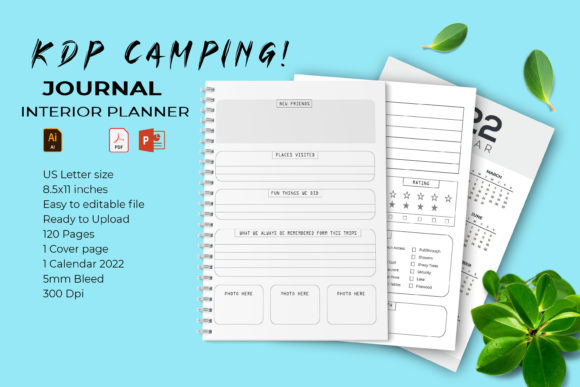
Camping Journal – KDP Interior’s is not a physical journal, but a complete, pre-formatted digital design package. It provides the foundational layout and graphical elements necessary to build a camping-themed journal for Amazon’s Kindle Direct Publishing platform. The package includes a 2022 calendar, cover page, and vector shapes, all formatted to KDP’s specifications. It’s a starting block—a professional interior template that removes the significant hurdle of initial design work.
This product fits into a broader publishing workflow as a specialized asset. Rather than spending hours designing page layouts from scratch or hiring a graphic designer, a publisher can acquire this interior file and immediately begin customizing it to fit their specific vision. It acts as a bridge between the conceptual idea of a camping journal and the technically compliant final product ready for upload to KDP.
Integrating the Interior into Your Publishing Workflow
The effective use of this template requires viewing it as a component within a larger process. Your workflow likely involves planning the journal's content, finalizing the design, and preparing files for publication. Here’s how Camping Journal – KDP Interior’s interacts with each stage.
Planning and Preparation Phase
Before even opening the design files, define the purpose of your journal. Is it for personal keepsakes, a gift, or a commercial product on KDP? Knowing this determines your customization path. The interior package, with its included 2022 calendar, provides a ready-made temporal structure. Your preparatory work shifts from structural design to content planning: deciding on additional prompts, log sections, or notes pages you might want to add around the provided framework.
Check compatibility with your software. The package includes AI, EPS, PPT, and JPEG files. If you’re proficient with Illustrator, the vector files offer maximum flexibility. For those more comfortable with PowerPoint, the PPT file provides an accessible editing environment. This initial compatibility check ensures a smooth transition into the execution phase.
Execution and Customization Phase
This is where the interior’s features directly integrate with your action. Opening the editable vector files in a program like Illustrator allows you to change colors, resize the 100 vector shapes, and reposition elements without loss of quality—thanks to the 300 DPI resolution. The “easy to editable” nature of the file is key. You can adapt the camping-themed graphics to match your specific branding or aesthetic preference.
Practical implementation involves a methodical approach. Start with the calendar page; ensure dates are correct for 2022. Then, move to the cover page, likely replacing placeholder text with your journal’s title and author name. Use the vector shapes—icons of tents, trees, campfires—to embellish other pages you create. The provided JPEG images serve as quick-reference backups or can be imported into other layout software if needed. Throughout this process, maintain the crucial technical specifications: the US Letter size (8.5 x 11 inches) and the NO BLEED PDF setup required for a straightforward KDP upload.
Finalization and Quality Control Phase
After customization, your workflow converges on output and testing. The package includes a ready-to-upload PDF file with no bleed. This is the final deliverable for KDP’s paperback interior uploader. Before uploading, however, integrate this PDF into your quality control routine. Print a copy at home or in your office using the print-ready file to check physical readability and layout. Verify that all your edits appear correctly and that the calendar is properly aligned.
This phase also involves integrating your now-customized interior with your final cover design. The interior’s cover page is a design template; you must ensure your final external cover file, uploaded separately to KDP, matches the interior’s theme and quality. The consistency between the external cover and the internal design, aided by the cohesive graphics from the interior package, enhances the professional feel of the final journal.
Beyond KDP: Other Applications in Your Routine
While designed for KDP, the utility of this interior extends into other personal and professional avenues. Its fully editable nature means it’s not locked to one platform. For educators or workshop leaders, the template could be adapted into a printable activity log for outdoor education programs. Bloggers or content creators might use elements from the JPEG files to enhance website posts about camping. Freelancers could use the base layout to create a client-specific journal for a outdoors-themed brand.
The long-term use stems from its vector foundation. Vector shapes are resizable without quality degradation, making the asset reusable for future projects. Perhaps you create a 2023 camping journal next year; you can use the same shape assets, updating only the calendar. This promotes efficiency and consistency across multiple projects or annual editions.
Key Factors for Smooth Integration
To seamlessly incorporate Camping Journal – KDP Interior’s into your project, focus on organization and understanding your tools. Keep the original downloaded files in a dedicated project folder. As you edit, save iterative versions (e.g., “Camping Journal_Edits_V1.ai”) to avoid losing work. Understand the difference between the bleed and no-bleed files; the provided “NO BLEED” PDF is for KDP paperback, while the bleed instructions are for potential professional print shop use outside of KDP.
Usability is high due to multiple file formats, but your proficiency with the chosen editing software is the final determinant. If you’re new to Illustrator, dedicate time to learn basic vector editing tasks like changing fill colors or moving objects. The PowerPoint option offers a more familiar interface for many, though with less granular control over vector graphics.
Finally, view this interior not as a rigid product but as a flexible component. Its value is in accelerating the production timeline and ensuring technical compliance. Your creative input—the content you add, the colors you choose, the way you market the final journal—transforms this template from a generic asset into a unique product that serves your specific goals, whether commercial or personal. By understanding its role in the workflow, you can leverage it effectively to bridge the gap between your camping journal idea and its tangible, high-quality reality.